
“You Did What?” Nullifying The Voting Rights Act
This article attacks the recent Supreme Court decision set to overturn the Voting Rights Act (1965).

“You Did What?” Nullifying The Voting Rights Act
The events of Wednesday, April 29, 2026, will be felt for years to come. As early as Monday, April 27, there were hints of what was to come from the Supreme Court on Wednesday, April 29, with the Louisiana vs. Callais decision.
The Political Wire posted the following, tipping off those who were sensitive to what was on the legal horizon.
DeSantis Proposes New Congressional Map for Florida
“Florida Gov. Ron DeSantis (R) unveiled a proposed congressional map that would create four new Republican seats in the Sunshine State.

“It would likely transform a delegation with 20 Republicans and eight Democrats into one with 24 Republicans and just four Democrats” (The Political Wire, April 27).
At the same time, the New York Times pointed to further interest in the nationwide gerrymandering battle.
What’s Next in the Nationwide Redistricting Fight
“A nationwide gerrymandering tug of war moves this week to the Florida Legislature and Virginia’s top court, the latest fronts in a lengthy battle Democrats and Republicans have fought to a rough draw so far,” the New York Times reports” (qtd. in The Political Wire, April 27).
One would suspect, then, that the decision from the Supreme Court on Wednesday, April 29, in the 6–3 decision of Louisiana vs. Callais, that there would be no radical surprise. However, this politically constructed decision passed down by the high court yielded a major blow to the 1965 Voting Rights Act, designed to give fair, credible, and more accurate representation, and structurally address voting discrimination and disenfranchisement of African Americans (read: the majority-minority Black communities) in the deep South, which historically has been racially and politically dominated by a minority-majority White, Republican representation.
Not The Time To Fall Asleep
These two early announcements may not have been the glaring foretelling of the Louisiana vs. Callais outcome. But these two posts did underscore a larger problem subtextually, and non-verbally communicated to most Americans, racism continues to be employed, expressed, and is more institutionalized than a mid-21st-century cultural ideology would like to believe.
Fair to say that most Americans may not be current with the 1965 Voting Rights Act, therefore making the Louisiana vs. Callais decision difficult to ascertain. Further, is it fair to say that most Americans naively assume that racism is, or has been, quarantined to a particular area in the U.S.? If so, the Louisiana vs. Callais decision should point out where to look to see how contemporary racism is being expressed: the deep South, with a growing reach across the country.
What makes this recent Supreme Court decision difficult to comprehend could equally lie in the minds of those who operate, think, and live outside of the political arena, namely, most Americans. Yet, if the Supreme Court was designed to be a barometer of the legal understanding and equitable posture of all Americans, then it would behove the populist to remain current with the cases and opinions applied and descending from the high court.
Viewing the Supreme Court as an alien fixture of the American governmental structure gives more fuel to the visible growing political agenda of the otherwise “blind” court. Seeing the law of the land (read: the American socio-political, cultural fabric) in respect to what must be followed without understanding or explanation turns the mechanics of the Supreme Court into a dreaded government course necessary to pass for some assumed cultural credit.
The day-to-day lived experiences of Americans should be far beyond a meaningless secondary school requirement. What the Louisiana vs. Callais opinion should do is give a shutter to think of what the future of the American socio-political landscape could, and quite possibly will, be in the coming decades as both Republicans and Democrats will entrench the battle to secure political leverage in the House of Representatives and Congress, starting at the grassroot level of state political districts, which provide the number of potential votes in favor of a particular political party.
This is not a second-period, drab time to do the bare minimum for a letter grade. This is, in fact, how racial identity, political voice, culture, jobs, education, finances, gender representation, and economy are defined: by the enlistment of the most credible and fair representation of a state, regardless of race. The Louisiana vs. Callais decision has started the process to dismantle and erode this process.
Why the Voting Rights Act?
“This act [The Voting Rights Act] was signed into law on August 6, 1965, by President Lyndon Johnson. It outlawed the discriminatory voting practices adopted in many southern states after the Civil War, including literacy tests as a prerequisite to voting.
“This ‘act to enforce the Fifteenth Amendment to the Constitution’ was signed into law 95 years after the amendment was ratified. In those years, African Americans in the South faced tremendous obstacles to voting, including poll taxes, literacy tests, and other bureaucratic restrictions to deny them the right to vote. They also risked harassment, intimidation, economic reprisals, and physical violence when they tried to register or vote. As a result, African-American voter registration was limited, along with political power.
“In 1964, numerous peaceful demonstrations were organized by Civil Rights leaders, and the considerable violence they were met with brought renewed attention to the issue of voting rights. The murder of voting-rights activists in Mississippi and the attack by white state troopers on peaceful marchers in Selma, Alabama, gained national attention and persuaded President Johnson and Congress to initiate meaningful and effective national voting rights legislation. The combination of public revulsion to the violence and Johnson’s political skills stimulated Congress to pass the voting rights bill on August 5, 1965” (National Archives, February 8, 2022).
What the Voting Rights Act secured was the available opportunity of African American/Black voters in the segregated American South, which had traditionally been defined by racist discrimination giving privilege to White male dominance. The political posture of the South has consistently favored the Republican Party. The Voting Rights Act employed the opportunity for the racialized South to involve African American/Black communities and provide a more relevant and accurate racial, cultural, and political profile.
It is this framework that the majority opinion from the Supreme Court set out to overturn, stating that the Voting Rights Act was, in fact, politically discriminatory. It is this decision, articulated in the 6–3 Louisiana vs. Callais decision, recognized along political ideological and party lines, from the Supreme Court that set a fire to the present socio-political understanding, recognition, and application of racism, law, bias, and discrimination.
How The Court Speaks
Writing in The Hill, Adam Liptak noted the following about Chief Justice John Roberts.
Chief Justice Roberts Played the Long Game
“Wednesday’s bombshell voting rights decision from the Supreme Court is a testament to Chief Justice John Roberts’s patience and penchant for the long game.
“As far back as 1982, when he was a young lawyer in the Reagan administration, he worked to oppose the expansion of a part of the Voting Rights Act of 1965, which had initially covered only intentional discrimination, to address practices that had discriminatory results. Back then, his efforts failed” (The Hill, April 30).
If this historic preference is understood by the current Chief Justice, John Roberts, it is plausible to read the Louisiana vs. Callais result as a retribution for lost time? Can it be read, as some legal analysts have stated, that the Louisiana vs. Callais response is a clear, vocal statement from a political court that has recently been operating through “shadow dockets” to overstep procedures and implement politically charged opinions and decisions.
Where is the Country Now?
Here’s the clearest and most succinct understanding of this Supreme Court ruling, issued on Wednesday, April 29, 2026.
“The Supreme Court’s conservative majority on Wednesday sharply limited a part of the Voting Rights Act that has forced states to draw voting districts to help elect Black or Latino representatives to Congress as well as state and local boards.
“In a 6–3 decision in Louisiana vs. Callais, the court ruled that creating these majority-minority districts may amount to racial discrimination that violates the 14th Amendment.
“When weighing what the Voting Rights Act requires, “we start with the general rule that the Constitution rarely permits the federal government or a state to discriminate based on race,” Justice Samuel A. Alito Jr. wrote for the court…Alito said states may draw election districts for partisan advantage but may not use race as a basis for redistricting” (The LA Times, April 30, emphasis added).
The point made by Justice Alito reverses the intent of the Voting Rights Act (1965), creating a pathway for historic, politically marginalized communities, as most reports have been codifying as African American/Black communities, but does relate to the various majority-minority communities throughout the nation (read: BIPOC, BILPOC), to obtain a visible presence and political voice. Justice Alito’s majority opinion opens the opportunity for voting districts to be drawn along political party lines, rather than negotiating the racial/ethnic demographic of an area to aid in the support of equity and a clearer representation of the voting body.
As of Wednesday, April 29, 2026, the Supreme Court has, in effect, granted a political party privilege over voting. The demographic of a territory is no longer considered. Rather, the political party that favors the region is held as the defining factor in how voting areas are structured.
The political ideology of the Supreme Court has become all the more present. To overlook this profound moment in time as little more than a typical opinion/dissent from the Supreme Court is naive. Juxtaposing Justice Alito’s opinion with Justice Elena Kagan’s dissent sheds light on the political body of the branch of government designed to be politically blind.
“The consequences of the ruling ‘are likely to be far-reaching and grave,’ said Justice Elena Kagan, adding that it will allow ‘racial vote dilution in its most classic form.’
“She said the decision means ‘a state can, without legal consequence, systematically dilute minority citizens’ voting power. Of course, the majority does not announce today’s holding that way. Its opinion is understated, even antiseptic.’
“But she said states across the South may draw electoral districts that deprive Black voters of equal representation. Justices Sonia Sotomayor and Ketanji Brown Jackson agreed” (The LA Times, April 29).
Mapping America
The clear political divide of the Supreme Court is elevated to a new political low point.
The Wall Street Journal noted how quickly the Republican Party has been to address this ruling, which is set to favor their overall political numbers in the upcoming midterm elections and certainly the 2028 election cycle.
Republicans Rush to Redraw Maps After Ruling
“Republican leaders are pushing for Southern states to rapidly redraw congressional maps ahead of the midterm elections, on the heels of a Supreme Court decision that sharply curbed the use of race in crafting electoral districts.
“The court’s ruling effectively extends a cycle of tit-for-tat redistricting in which Republican- and Democratic-led states have scrambled to create new districts that could give their party an edge in the fight for control of the House of Representatives in November.
“Now cartographers, state legislators — and lawyers — are heading into extra time” (Wall Street Journal, qtd. in The Hill, April 30).
An interesting turn is the state of Georgia, which, as noted in the Atlanta Journal-Constitution, quoted in the Political Wire on May 1, stated that there would be no redrawing of the political lines.
Georgia Will Not Try to Redraw Maps This Year
“Gov. Brian Kemp made clear Friday he won’t cancel Georgia’s May 19 primary or rush to impose new political maps on this year’s elections after the U.S. Supreme Court weakened a key pillar of the Voting Rights Act,” the Atlanta Journal Constitution reports” (qtd. in The Political Wire, May 1).
Why would this state not desire to redraw its political maps? The answer lies in the Republican stronghold, which defines the state. Ballotpedia noted the following,
“The Republican Party is the dominant political party in the U.S. state of Georgia. As of April 2026, Georgia has a Republican trifecta — the Republican Party controls the governor’s office, both chambers of the state legislature, and key executive offices such as the secretary of state and attorney general” (Ballotpedia, May 1).
The governor, Brian Kemp (R), would see no need to redraw the current political lines, given this majority ruling. However, the “Republicans hold about 26.9% of Georgia’s registered voters, Democrats about 42.97%, and the remainder are independents or unaffiliated” (Independent Voter Project, April 2026).
If this is the case, one would suspect that the state would need to have the voting district maps redrawn, following the recent Supreme Court ruling. However, if the state of Georgia maintains such firm control of the highest offices in the state, making the claim that there will be no rush to, nor need to, redraw the political maps may appear bold, but, in reality, this movement saves the power of the Republican dominance in the state.
Will Georgia serve as a bellwether for other Republican states? One would suspect the rhetorical answer to be “Yes.” But, if there’s one stable response coming from this blindsiding decision by the largely conservative Supreme Court is that assumptions should not be made.
Decisions, Decisions, Decisions
“The decision was the latest example of a partisan political dispute in which the court’s six Republican appointees voted in favor of the Republican state plan, while the three Democratic appointees dissented” (The LA Times, April 29).
It’s important to note that the 1965 Voting Rights Act had a strong revision in 1980/1982. The largely Southern Republican states remained in dominance over the minority Black Democratic representation.
A 1980 legal case from Mobile, Alabama, contested the appointment of a small majority of White politicians in an area that had a voting body of 1/3 African American/Black. A revision to the Voting Rights Act took place in 1982 in response to this action, providing for equitable and legal representation of a specific community.
“The Supreme Court upheld this arrangement as legal and constitutional. In dissent, Justice Thurgood Marshall said Black residents were left with the right to cast meaningless ballots.
“In response, Congress amended the Voting Rights Act in 1982 to say states must give minorities an opportunity to elect representatives of their choice.
“Four years later [1986], the Supreme Court interpreted that to mean that states had a duty to draw voting districts that would elect a Black or Latino candidate if these minorities had a sufficiently large number of voters in a particular area” (The LA Times, April 29).
Is It Still Going To Be One for One?
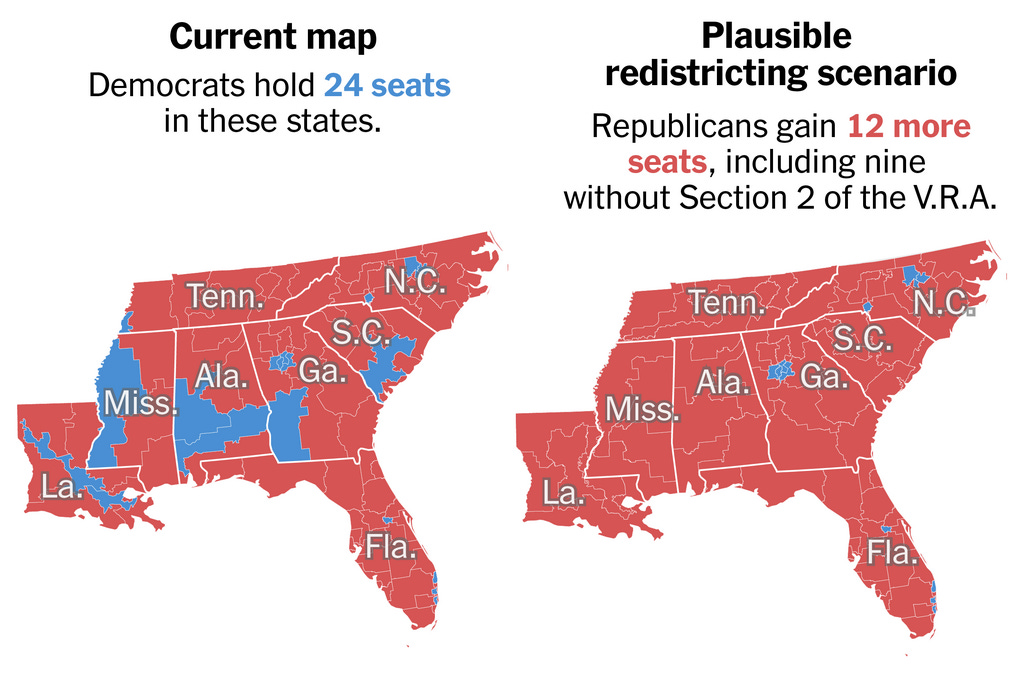
The map of current and plausible redistricting is worth the proverbial thousand words.
The Hill notes the following outcomes and history of the gerrymandering between both major political parties.
A Dangerous Choice for Democrats
“After the Supreme Court’s six Republican-appointed justices effectively dismantled a key part of the Voting Rights Act on Wednesday, attention has turned to how Republican legislatures may dismantle districts that help minority voters elect their candidate of choice and replace those districts with Republican gerrymanders.
“But as bad as the redistricting prospects are for minority voters in Republican-run states after Louisiana v. Callais — and they are very bad — it’s worth considering how Democratic-run states, too, will have an incentive to dismantle some of these districts. The battle over whether to maximize the number of Democratic seats or provide effective minority representation in Congress and other legislative bodies could threaten the Democratic Party’s internal cohesion and long-term prospects.
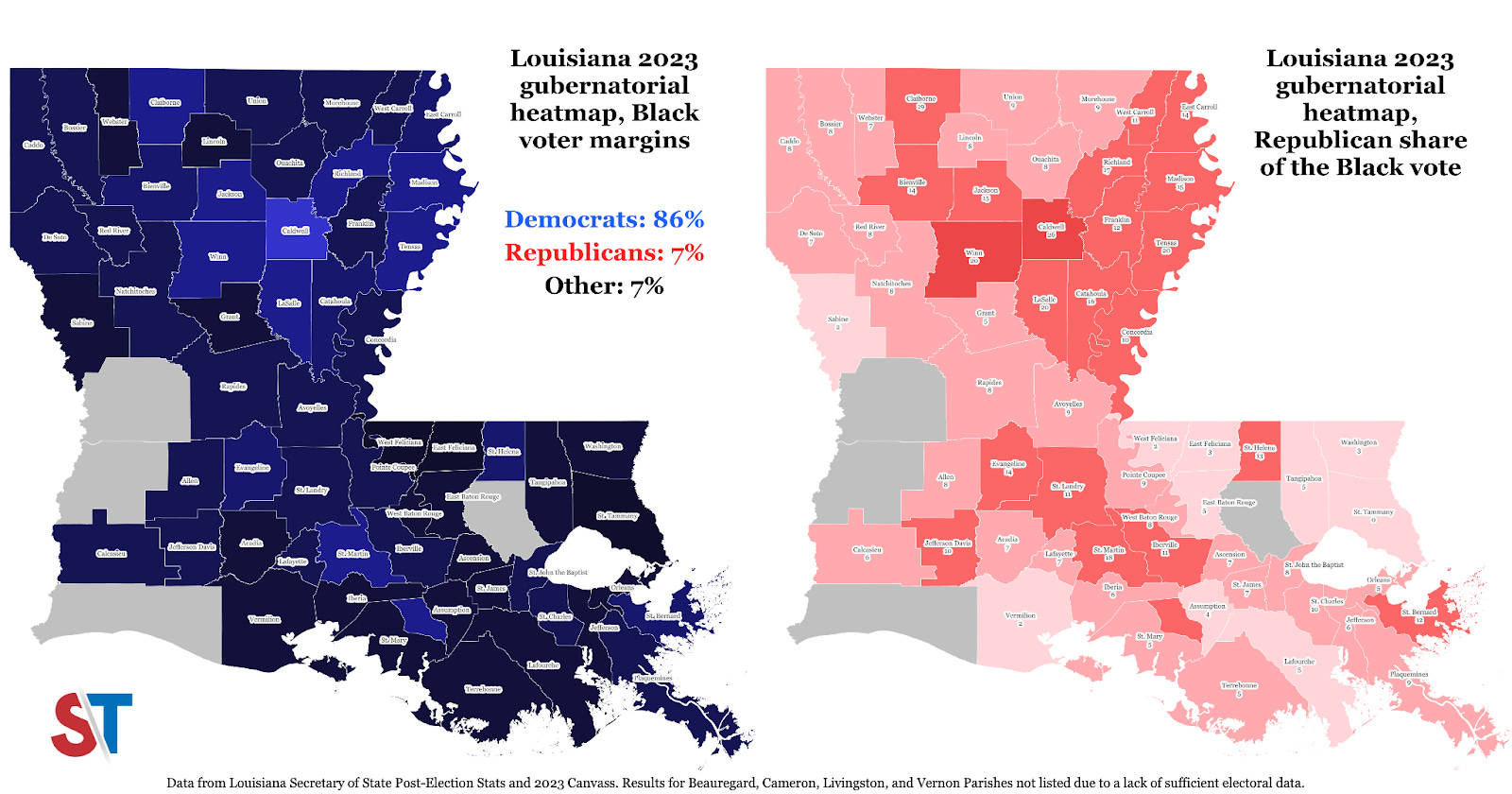
“To understand how clashes may emerge, begin with the fact that Black voters are far and away the most reliable source of Democratic support — in some places, Democrats win 90% of Black voters” (Rick Hasen, The Hill, April 30).
Then there’s the history of how political gerrymandering was seen and used by the Democratic Party to help elevate its political position. The New York Times provided the following reference.
Good Government Is Bad Politics When It Comes to Maps
“Not long ago, Democrats had dreams of restoring fairness to America’s grotesquely gerrymandered political maps,” the New York Times reports.
“Their party began a major push for independent commissions to draw congressional districts after President Trump and Republicans swept into power in 2017. Democrats, panicked about Republicans’ structural gains after the 2010 census, succeeded in enacting such commissions in Colorado, Michigan, and Virginia, while Republicans mostly kept politically minded state legislators in charge of drawing maps in red states.”
“Now Democrats are finding that their old good-government policies have become bad politics” (The New York Times, qtd. in The Hill, April 30).
How The Media Speaks
In a Democracy Now! post on April 30, lawyer and civil rights activist Maya Wiley, head of the Leadership Conference on Civil and Human Rights, calls Wednesday’s ruling “a free pass to discriminate” (Democracy Now!, April 30). The entire episode can be viewed here: https://www.democracynow.org/shows/2026/4/30?autostart=true
Further news reports on the Louisiana v. Callais result give varying analyses, each centering on the common theme of how this decision will potentially affect the overall socio-political landscape, with a deeper grip on privilege and the re-application of segregation.
News and Entertainment, MS NOW, The 11th Hour With Stephanie Ruhle April 29, 2026, MSNBC Breaking News Today April 29, 2026, [start at 18:07]
Cameron Arcand, Daily Wire Plus, “Supreme Court Rules On Key District Case With Ripple Effects Nationwide,…Ruling could reshape redistricting fights nationwide as court tightens rules,” April 29, 2026, [Listen to the article]
“The Supreme Court delivered a major 6–3 ruling Wednesday, striking down Louisiana’s congressional map in Louisiana v. Callais after the state added a second majority-black district…The Court said that the move wasn’t required under the Voting Rights Act, so using race to draw it made the map unconstitutional. The decision doesn’t eliminate Section 2 but could impact redistricting fights nationwide” (Daily Wire Plus, April 29).
Jacob Wheeler, Daily Wire Plus, “Supreme Court Ruling Cracks Open Redistricting War, and Republicans See Path To Power Shift.”
“The decision is expected to recharge a nationwide redistricting battle that could reshape the balance of power in Washington” (Daily Wire Plus, April 29). Listen to the article
“The U.S. Supreme Court on Wednesday sharply limited the ability of states to consider race when drawing congressional maps, a decision that could reshape the balance of power in Washington and intensify redistricting battles ahead of the 2026 midterms…Writing for the majority, Justice Samuel Alito struck down Louisiana’s congressional map, which included two majority-black districts, as an unconstitutional racial gerrymander (Daily Wire Plus, April 29).
The importance and scope of a racialized American political body, concerning the witnessed overturning of the Voting Rights Act, continues to be a central thread. How Article 2 of the Voting Rights Act is being reviewed, as racial discrimination, marginalizing the historic White, Republican minority-majority of the South, has been brought to light, and should be more of a concern for legal analysts and civil rights activists.
“SEC. 2. No voting qualification or prerequisite to voting, or standard, practice, or procedure shall be imposed or applied by any State or political subdivision to deny or abridge the right of any citizen of the United States to vote on account of race or color” (National Archives, February 8, 2022, emphasis added).
MS NBC News Now, Hallie Jackson NOW, April 29, [start at 26:30]
What does gerrymandering accomplish?
Taking a look at the definition of gerrymandering, it becomes apparent why this issue is politically centered.
“[A]n occasion when someone in authority changes the borders of an area [to] increase the number of people within that area who will vote for a particular party or person” (Cambridge Dictionary, n.d., accessed April 30).
The leverage of this action by the Supreme Court clearly articulates a political change. The action resumes a visible legal discrimination and marginalization of, in this case, African American voters. Yet, this movement will have a reciprocal effect on other majority-minority communities (read: BIPOC/BILPOC) across the U.S.
Focusing on the change of voting to advantage one political party was a firm application and importance of the 1965 Voting Rights Act. The Supreme Court majority opinion has successfully set in motion the process to legally gerrymander districts, institutionalize segregation, and politically allow for racial discrimination. The progression of the American socio-political fabric has been ripped apart. The coming voting cycles will articulate how deep this cut goes into the American political flesh.
National Public Radio’s Up First program on April 30 wrote the following,
“The U.S. Supreme Court ruled yesterday that Louisiana’s 2024 election map was an “unconstitutional racial gerrymander.” The map established a second majority-Black congressional district. The justices’ 6–3 decision fell along partisan lines. While the court technically kept Section 2 of the Voting Rights Act intact, the ruling contributes to a series of decisions undermining the landmark 1965 law that protected racial minorities’ collective voting power. Experts expect the ruling to reduce minority representation across all levels of government.
“The court’s ruling reinterprets the longstanding protections against racial discrimination in Section 2, NPR’s Hansi Lo Wang says. Decades ago, Congress amended the Voting Rights Act to say that Section 2 should focus on any discriminatory effects of a redistricting plan. Justice Samuel Alito wrote in the court’s majority opinion that the focus of Section 2 should be intentional racial discrimination. Legal expert Atiba Ellis tells Lo Wang that proving racist intent is notoriously difficult, and the ruling essentially asks plaintiffs to “now find a smoking gun.” Lo Wang adds that with a further weakened Voting Rights Act, the U.S. could see the largest-ever decline in representation by Black members of Congress” (NPR, Up First, April 30).
What does this say about other majority-minority racial/ethnic communities (read: BIPOC/BILPOC) in America? The strength of ghettoization has gained more legal leverage and political power. Guised as gerrymandering, the availability of the Voting Rights Act (1965) to support and provide equity in voting for disenfranchised communities, the Supreme Court decision dismantles this process not only for limited urban environments, but reaches across the country as the highest court in the nation passed this 6–3 decision.
Obviously, Legal Opinions Do Matter
The Los Angeles Times posted on April 30,
Supreme Court limits Voting Rights Act in setback for Black Democrats
“The Supreme Court’s conservatives announced a major retreat from part of the Voting Rights Act that has forced states to elect at least some Black or Latino representatives to Congress as well as state and local boards” (The LA Times, April 30, Listen to the article).
What is striking is how this ruling is viewed by supporters and opposition agents. In an op-ed for the Political Wire, Rick Hasen noted the following,
The Worst Ruling in a Century
“Wednesday’s 6–3 party line decision in Louisiana v. Callais will go down in history as one of the most pernicious and damaging Supreme Court decisions of the last century.
“All six Republican-appointed justices on the court signed onto Justice Samuel Alito’s opinion gutting what remained of the Voting Rights Act protections for minority voters, while pretending they were merely making technical tweaks to the Act.
“This decision will bleach the halls of Congress, state legislatures, and local bodies like city councils, by ending the protections of Section 2 of the Act, which had provided a pathway to ensure that voters of color would have some rudimentary fair representation. It’s the culmination of the life’s work of Chief Justice John Roberts and Samuel Alito, who have shown persistent resistance to the idea of the United States as a multiracial democracy, and a brazen willingness to reject Congress’s judgment that fair representation for minority voters sometimes requires race-conscious legislation…It gives the green light to further partisan gerrymandering. It protects Alito’s core constituency: aggrieved white Republican voters. It’s a disaster for American democracy” (The Political Wire, April 29, emphasis added).
The evidence points to the dramatic ramifications of the high court’s decision. Regardless of the political alliance, the outcome of Louisiana v. Callais has changed the racial, cultural, and political landscape of the country for decades to come.
What Is At Stake For The Future?
Striking to recognize is how the Supreme Court has reversed constitutional borders established to protect marginalized communities along the lines of racial discrimination. The power of the high court has been flexed along political ideological lines.
Is it naive for Alexandria Ocasio-Cortez (D) to make a statement calling for “balance”?
“We have to all abide by the same rules. If Republicans are going to redraw North Carolina, if they’re going to redraw Texas, if they’re going to redraw and gerrymander every one of their states, then unfortunately we have to provide balance to that until we get to the day when we can all finally agree to put this behind us and pass nonpartisan gerrymandering federally,” Rep. Alexandria Ocasio-Cortez (D-NY), speaking to reporters when asked if New York should respond with its own redistricting (qtd. in The Political Wire, April 29, emphasis added).
It is safe to say that the blind court has a clear political vision. The question to probe is whether the future of the Supreme Court will continue to operate along political lines to serve the seated administration, or if the possibility for the law of the land to resume a position of political neutrality, serve the country, stand by the pillars of the American Constitution, or retain the present direction, working with secret notes, unilateral legal decisions, and operating to satisfy the ideological agenda of the dominant political party.
The lead weight on the scales of the law appears to be heavier than previously assumed.
Alan Lechusza Aquallo